

Distant Voices
Putting unheard voices on the map, with AI.
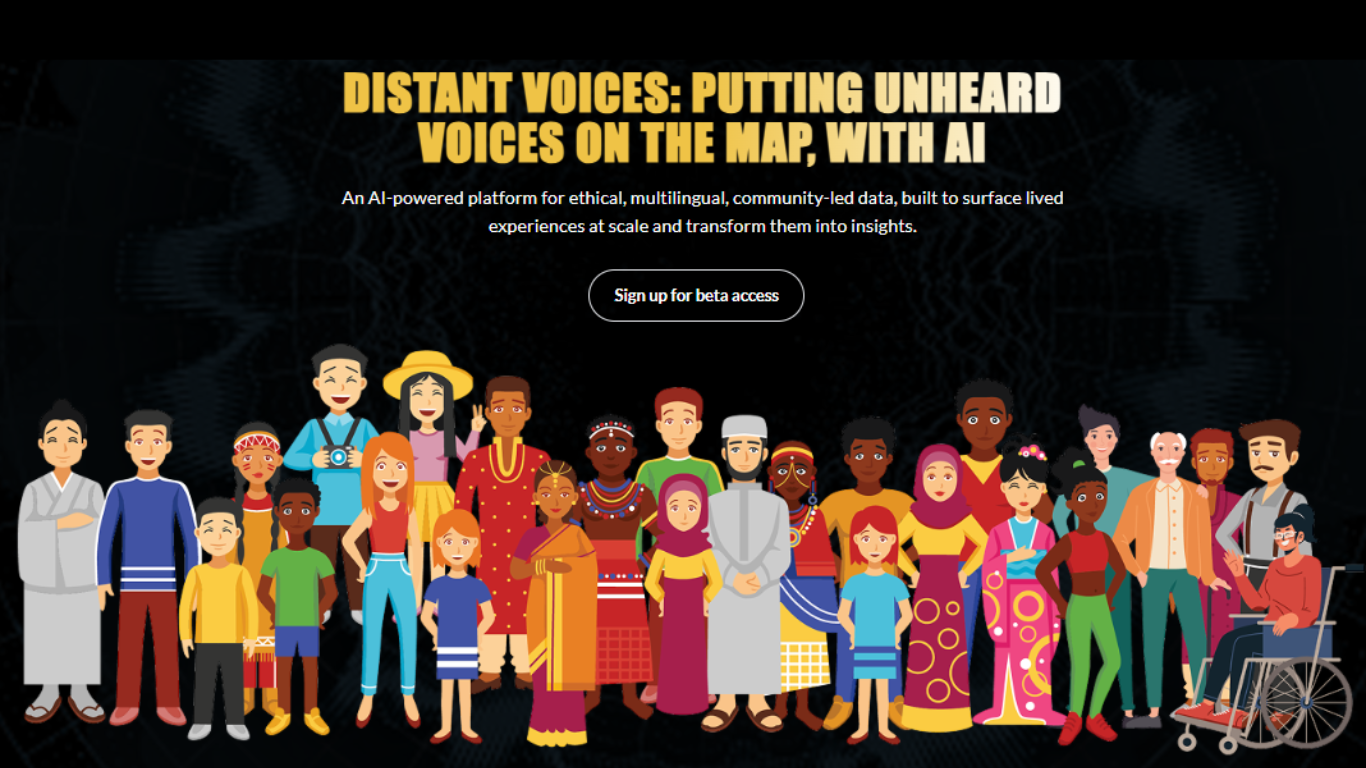
An AI-assisted platform that turns real-world conversations into community intelligence for organisations serving marginalised communities.
Why Distant Voices exists
Nineteen years ago, Ushahidi was built to let people report what was happening from wherever they stood. That idea — that proximity to a crisis is a form of expertise — has underpinned more than 200,000 deployments across 160 countries and 50 million reports. AI creates the same opening today that social media and mobile connectivity created then. But the communities hardest hit by climate change, conflict, and displacement are still the least represented in the evidence that shapes policy.
Distant Voices closes that gap. It layers AI onto Ushahidi's foundation of community trust and open-source infrastructure, making it possible to collect, process, and verify community intelligence at a speed and scale that no manual process can match. A farmer in rural Nigeria should not need a 40-question survey to be heard. A voice note on WhatsApp in Yoruba should be enough.
The scale of what that means in practice became clear in June 2024, during Kenya's #RejectFinanceBill protests. A team of ten people using an early version of the Distant Voices pipeline processed 1.2 million data points in hours. Doing the same work during the 2022 elections had taken more than 100 volunteers several days. The 2024 deployment was 120 times faster — and that comparison is not primarily about speed. It shows that real-time community intelligence is now achievable without the resources that previously made it the preserve of large, well-funded operations.
200K+ | 160+ | 19 | 68.4M+ |
|---|---|---|---|
Number of deployments on the Ushahidi Platform | Number of countries the Platform has been used in | Years Ushahidi has been in existence | Number of reports processed on the Ushahidi Platform |
What Distant Voices delivers
Organisations come to Distant Voices at different points in a programme cycle. The platform serves three distinct needs.
Participation | Evaluation | Decision Intelligence |
|---|---|---|
Collect community voices at scale via WhatsApp, Telegram, SMS, voice messages, and social media, in whatever language people use. | Finding patterns across large volumes of submissions, tracking how they change over time, and turning them into insights across regions and groups. | Tracking whether programmes are working, spotting emerging issues early, and producing evidence for resource allocation, programme design, and policy. |
These three modes share one underlying process.
- Ingest: ** ** Submissions arrive via WhatsApp, Telegram, SMS, voice messages, and social media in whatever language communities use.
- Process: Each submission is transcribed from audio if needed, translated, cleaned of duplicates, and tagged with a location.
- Analyse: AI then groups submissions by theme, assesses relevance, and flags potential misinformation.
- Review: A human review team checks the AI's work before any findings leave the platform.
- Deliver: Intelligence is then delivered through whichever format the partner needs: a live dashboard, a written report, an automated alert, or a direct data feed into the partner's own systems.
The analysis has evolved significantly from earlier approaches. Where word frequency charts once showed "water" as a common term, Distant Voices surfaces "water scarcity" as a theme, grouping drought reports, well access complaints, and contamination cases by geography. Partners understand not just what words communities use, but what those words mean in context. The next stage of development is moving from sentiment scoring to narrative analysis, detecting emerging issues before they become visible in aggregate data.
Language handling is a core deployment design decision, not an optional feature. In rural Nigeria and Kenya, English often dominates social media even when daily conversation happens in local languages. Low-resource languages are more likely to surface on voice platforms and radio. Distant Voices routes submissions to different AI models depending on language and region: OpenAI for Yoruba and Kiswahili, Ghana NLP for Luo, Lelapa AI for other low-resource African languages. The platform is supported by research partnerships with Oxford University on governance, Harvard University, Ghana NLP, and CIPIT/Strathmore. All data is handled in line with applicable data protection law, including informed consent, anonymisation, encryption in transit and in storage, and role-based access controls.
Proof: Two Climate Deployments
Distant Voices has completed two live climate deployments, inNigeria and inSiaya County, Kenya. Both ran in the second half of 2025, exceeded their submission targets and produced findings that have entered government planning processes. Together they demonstrate what the platform can do and what it has learned about how to do it well.
Nigeria, with NetHope and YARN || July to December 2025
Before a single submission was collected, Ushahidi, NetHope, and Youth in Agroecology and Restoration Network (YARN) held discovery sessions across Oyo, Osun, and Ondo States, bringing together government officials, civil society, farmers, and youth to co-design the data collection framework. That process shaped the classification keywords around how communities actually describe climate — not how researchers expect them to — and trained YARN's community data champions on the Ushahidi mobile app. The co-design stage is part of what makes the subsequent data trustworthy.
The target was 5,000 submissions. The deployment collected 9,506, through a hybrid model that combined YARN's field-based mobile collection (63%, split roughly equally across all three states) with Distant Voices social listening across Nairaland, X, and Facebook (37%). The field collection specifically reached semi-urban and rural populations, women, elders, and people with limited digital access — the groups that online-only approaches consistently miss.
The data confirmed what the discovery sessions had suggested: communities describe climate in terms of what it does to their lives. A farmer in Osun said: "I had to plant maize twice this year. The first time it dried up before sprouting." A fisherman in Ondo: "No more fish. We wait hours. The water is hot, and fish are dying." A resident of Ayetoro, a coastal community in Ondo: "Sea has taken our land. We don't sleep in peace anymore. Every rainfall is fear." Thematic grouping made those signals visible as climate evidence. In raw, unclassified data, they would have appeared as complaints about fishing, farming, and weather — unconnected, uncounted.
Validation meetings in November 2025 brought the findings to ministries of agriculture, environment, and women's affairs across all three states, alongside traditional leaders, farmers' associations, and civil society. Ministries committed to integrating the findings into their programming: adjusting school hours during heatwaves, revising agricultural extension curricula to include community-identified adaptation strategies, and using the data to identify high-risk areas in state climate adaptation plans. NetHope returned for a second deployment.
Siaya County, Kenya, with GIZ Kenya and Kijiji Yeetu || Late 2025
In Siaya County, on the shores of Lake Victoria, farmers have a phrase for what climate change has done to their lives. The rains, they say, no longer follow the calendar. They come late, stop too early, or fall in a single violent afternoon instead of spreading across a season. The Lake Basin region has long been underrepresented in Kenya's national climate planning despite worsening floods, droughts, and land degradation. The Siaya deployment set out to close that evidence gap in Ugunja Sub-County.
"You cannot know when to plant anymore. The seeds either rot in the soil or dry up." Farmer, Ugunja Sub-County
The target was 6,000 online submissions. The platform collected 103,619. A county by-election and a period of national mourning dominated the online conversation during the collection window, flooding the data with political content. Of the 103,619 submissions, 3,437 were verified as climate-relevant after AI-assisted grouping, human review, and on-the-ground verification by Kijiji Yeetu field staff. A further 1,960 voices were captured through door-to-door interviews conducted in Dholuo, Kiswahili, and English, reaching the farmers and rural residents who do not appear in online data.
103,619 | 3,437 | 1,960 |
|---|---|---|
online voices collected | verified as climate-relevant | captured through interviews |
The gap between 103,619 and 3,437 is the most instructive finding from Siaya. It is not a failure rate. It is a demonstration of what the hybrid model exists to do: separate signal from noise at a scale no manual process could manage, and produce verified findings that a county committee can actually use. Online data collection alone would not have been sufficient. The by-election made that concrete. Field presence, local knowledge, and human review are not supplementary to the AI pipeline. They are structural.
The verified data showed a community under compounding pressure: floods contaminating water and driving malaria, typhoid, and cholera; heat drying water pans and exhausting outdoor workers; women and girls walking hours longer for clean water. The deployment's most striking finding came from the community validation sessions themselves, where residents connected rising petty theft of farm produce and livestock directly to climate hardship. When a harvest fails or drought wipes out livestock, income disappears and pressure moves into the community. For participants, climate change had become a question of social stability and safety, not only of agriculture.
The recommendations from those sessions are now channelled into the Siaya County Climate Change Action Plan and the Ugunja Integrated Development Plan, with technical support to the county climate planning committee and a dedicated policy brief. A season of community conversations about failing rains entered county policy.
Where Distant Voices is working now
The same pipeline that surfaces climate signal from community voice is now being applied across civic participation, electoral integrity, and digital governance in Kenya, through three active deployments. All are ongoing, and we will share findings as they emerge.
Hanns Seidel Foundation (HSF), with ECJP — Kisumu and Laikipia Counties. In partnership with the Hanns Seidel Foundation and the Ecumenical Centre for Justice and Peace (ECJP), Distant Voices is running a social-listening pilot to understand whether civic-education programming is shifting public conversation. The deployment listens across public conversation on Facebook and X in Kisumu and Laikipia, organising what it finds around a set of agreed analysis areas: shifts in sentiment, in how civic issues are framed, and in community priorities over time. The aim is to give HSF and ECJP an evidence-based read on the impact of their civic-education work, at the level of aggregate public narrative rather than individual tracking, consistent with the platform’s do-no-harm principles. The pilot is underway, and findings will be shared as the listening builds a picture over the coming months.
ForumCiv — Sauti Yetu, Amani Yetu. With ForumCiv and its partners, Distant Voices supports a youth-focused early-warning and civic-participation initiative ahead of the 2027 elections. The deployment combines national social listening with community reporting through SMS and WhatsApp, in English and Kiswahili, to surface emerging tensions, harmful narratives, and the concerns young people are raising, early enough for partners to respond. As with every deployment, reports are treated as signals for human review rather than verified facts, and the emphasis is on reaching young people, including women, rural, and informal-settlement youth, through the channels they already use. This work is ongoing, and insights will be shared as they emerge.
GIZ — “Towards Just(er) Digital Governance,” AI governance consultation. With support from the GIZ project “Towards Just(er) Digital Governance,” Distant Voices is being used to bring community voice into how Kenya governs artificial intelligence. Rather than leaving AI policy to institutional and expert circles alone, the deployment creates accessible ways for Kenya’s technology and public-interest communities — developers, data scientists, researchers, digital-rights and civic-tech organisations, AI startups, local-language technology builders, and civil society — to share their views, in their own languages. The work will gather around 2,000 multilingual contributions, process and categorise them, and turn them into a Community Insight Brief and a Policy Brief to inform Kenya’s National AI Strategy and emerging regulation. As throughout the platform, AI assists with transcription, translation, cleaning, and classification while people remain responsible for the findings. It is a proof of concept, deliberately designed to be documented and reusable elsewhere, and it is ongoing, with insights to be shared as the consultation progresses.
What makes Distant Voices work
1. Community trust that cannot be replicated quickly
Ushahidi has relationships with grassroots organisations, governments, and agencies across 160 countries, built over 19 years. Those relationships are why communities participate, why local partners engage as field teams, and why submissions arrive in local languages. YARN in Nigeria and Kijiji Yeetu in Kenya made participation possible in ways that a technology platform cannot substitute for. No new entrant can acquire that kind of trust quickly.
2. Human review as architecture, not an afterthought
AI handles transcription, translation, thematic grouping, and flagging. Human reviewers check the AI's work before findings reach partners. That step is designed into the pipeline at a fixed point, not added as optional quality control. At 103,619 submissions with substantial political noise, the Siaya deployment's 3,437 verified findings were only usable because verification was structural. The goal is to direct human judgment to the decisions that matter most — not to remove it.
3. A Data Commons built on consent
Each deployment contributes to a shared repository of community intelligence. Ushahidi generates revenue from intelligence and repeatable services, not from selling raw community data. The repository is being built with explicit agreement from deployers, expanded to include voice recordings and new languages, and organised for AI model training. Communities contribute more willingly when they understand that their data will not be extracted and sold. The underlying infrastructure is open source. The intelligence layer on top is where Ushahidi's services operate.
What is being built now
Work continues making each pipeline step more consistent and reliable across contexts and languages, including a steadily growing set of supported languages: Afrikaans, Amharic, Arabic, Chinese, Dutch, French, German, Hausa, Luganda, Portuguese, Shona, Somali, Swahili, Ukrainian, Wolof, and Zulu. Six areas are in active development: improving the thematic classifier so it explains its relevance judgments rather than returning a binary flag; refining speech-to-text accuracy starting with Chichewa for a Malawi deployment, then Kiswahili; building auto-detection for language routing with graceful fallback and human-review flagging when confidence is low; integrating verification checks throughout the pipeline rather than only at the end, including community signals such as comments and reactions; improving geographic tagging accuracy, including exploring integration with Dataminr; and moving from sentiment scoring toward narrative analysis and early trend detection.
Working with Distant Voices
Distant Voices is available through partnership today. Ushahidi configures collection channels, defines classification frameworks, connects local field partners, and delivers intelligence in whichever format the partner needs. At this stage, it is a managed service, combining the AI pipeline with Ushahidi's partner network and human review capacity.
In Nigeria, a framework co-designed with communities before collection began meant findings reflected how people actually described climate — and three state governments committed to acting on what the data showed. In Siaya, 103,619 community submissions became 3,437 verified findings, a policy brief, and a place in two county planning instruments. From community voice to the policy table: that is the distance Distant Voices is built to close.
2
Complete projects that implemented Distant Voices
3
Active Distant Voices Deployments
103619
Online voices collected in Siaya
9506
Number of submissions collected in Nigeria