
Seven Colours, Seven Tracks: Reflections from the MenCare Changemaker Summit, Rio
Jun 30, 2026
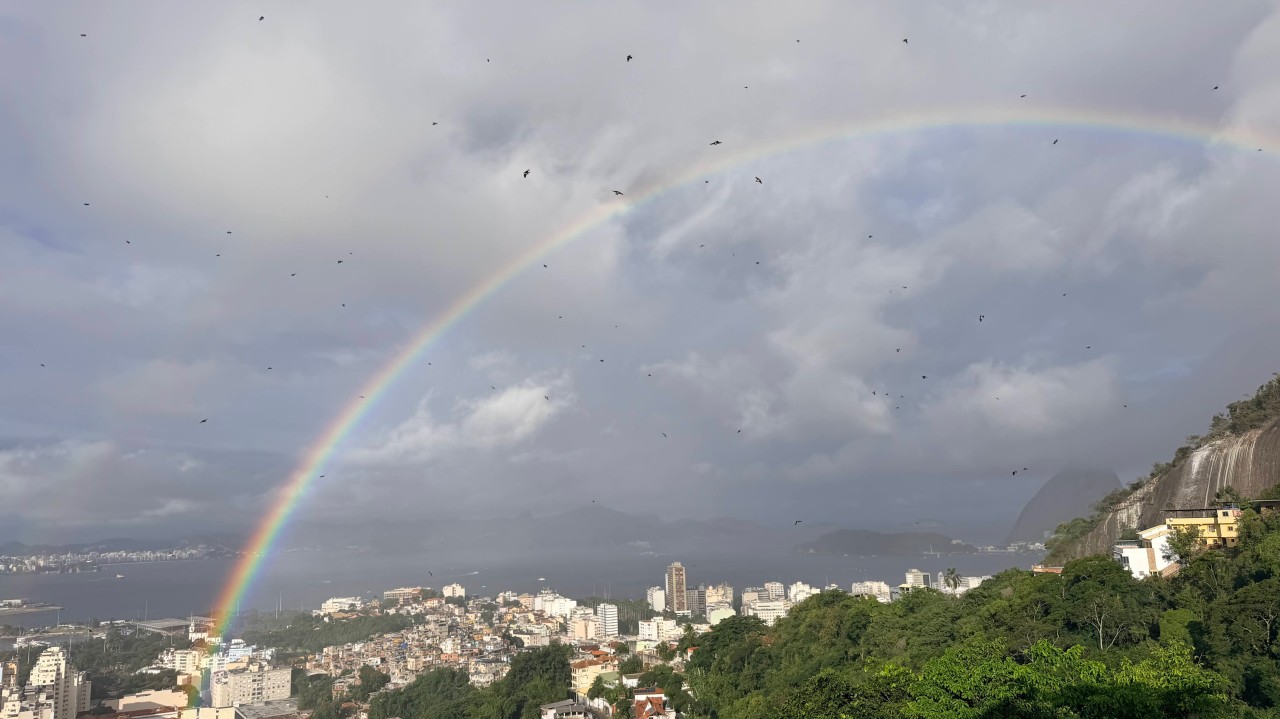
As I stood atop Santa Teresa hill taking in the Rio bay, a rainbow stretched across both ends of the skyline — a fitting way to begin the week.
I was in Rio for the MenCare Changemaker Journey, a global initiative led by Equimundo: Center for Masculinities and Social Justice, in partnership with WOW - Women of the World, which brought together 100 Changemakers from over 40 countries. I was part of the Caring Online Spaces track, working on a question I find genuinely urgent: how do we build digital environments that are good for boys and men, not just less harmful?
Growing up without the internet, I built community outdoors — shared playgrounds, borrowed game consoles. That texture of connection is increasingly rare for boys today. Our track spent two days on this problem with a diverse group: game designers, mental health advocates, child rights researchers, online safety experts, youth workers. The framing we arrived at stuck with me: the crisis facing boys online is not a crisis of behaviour — it's a crisis of agency. Platforms that remove friction make effort unnecessary and meaning elusive.
Much of this conversation gets framed through a Global North lens, but the pressures are just as real in Africa. Men in the gig economy — Nairobi, Lagos, Dar es Salaam — are economically precarious, separated from family networks, spending hours on their phones between jobs. Betting platforms offer quick gains and reinforce a transactional masculinity that isolates men further. The summit's central premise — that caring for boys leads to a more caring society — holds up against that reality. My own experience in a mentorship group for boys and their male caregivers bears it out: equip boys with an honest picture of masculinity, build community with them offline, and they carry that into how they show up online. The solution to the online crisis may be built largely away from screens.
 [Photo: At the MenCare Changemaker Summit]
The seven action tracks could have produced seven isolated conversations, but the connections were hard to miss. The Democracy, Violent Extremism and Tech-Enabled Harms track made one explicit: there is a direct pipeline from online misogyny to violent extremism. These aren't parallel problems.
A highlight on Day 3 was the Little Africa walking tour, part of the Boys and Men Festival. The tour traces the African diaspora through Rio's Port Region — repression, deliberate erasure, living memory. Walking those streets, I was reminded that the fight for equality, whether racial or gender-based, is never won quickly. And yet out of centuries of that struggle, something as joyful as the Samba was born. Will we achieve gender equality in our lifetimes? Perhaps not fully. But we need to try.
 [Photo: Little Africa walking tour. Credit @conectandoterritorios]
At the Thought Leaders Forum, the point was made plainly: the MenCare movement and the women's empowerment movement are complementary, not competing. Caring masculinity must not come at the expense of continued progress for girls and women.
The MenCare Changemaker Journey spans seven tracks — the same number as the colours in that rainbow over the bay. As work continues toward Melbourne in 2027, my hope is that we weave these threads into something as coherent and as beautiful. I left Rio more hopeful than when I arrived.
The MenCare Changemaker Journey is led by Equimundo: Center for Masculinities and Social Justice, in partnership with WOW - Women of the World. It is funded by the Caring Masculinity Fund, with additional support from the Gates Foundation, Minderoo Foundation, Pivotal Ventures, Procter & Gamble, The Rise Together Fund, and the W.K. Kellogg Foundation.
Find out more: changemakers.equimundo.org